
Driver walkaround checks in Ireland: what operators are expected to do
A practical guide to daily driver walkaround checks for Irish fleet operators: what a check covers, who is responsible, and what to record as evidence.
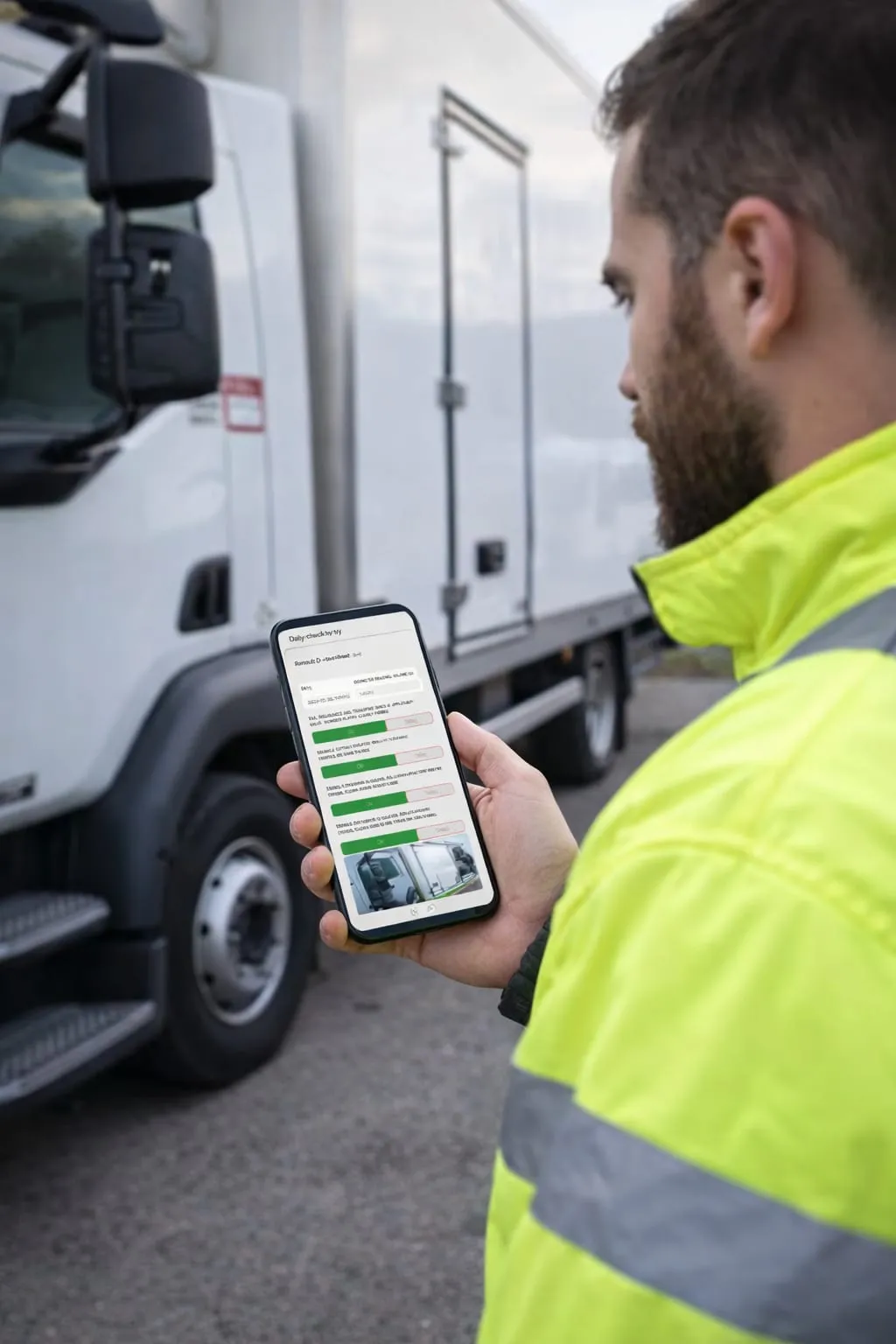
If you run commercial vehicles in Ireland, the daily walkaround check is the single most routine piece of compliance work your operation does. It happens every morning, on every vehicle, usually in the dark and usually in a hurry. It is also the thing most likely to be looked at when something goes wrong.
This guide covers what a walkaround check involves in practice, who carries the responsibility, and what separates a check that would stand up to scrutiny from one that would not.
What a walkaround check actually is
A walkaround check is a visual and functional inspection carried out before a vehicle is used, to confirm it is in a roadworthy condition. The person doing the check — normally the driver — walks around the vehicle, checks the items that can be seen or tested without tools, and records the result.
The point is not to replace a mechanic. It is to catch the things that deteriorate between services and that a driver is well placed to notice: a tyre that has lost pressure overnight, a light that has failed, a mirror knocked out of position, a load restraint that is damaged.
What a check typically covers
The exact list depends on the vehicle, but a walkaround check on a commercial vehicle generally covers:
- Tyres and wheels — condition, visible damage, inflation, wheel nuts and any signs of movement
- Lights and indicators — headlights, side lights, brake lights, indicators, hazards, marker lights and reflectors
- Mirrors and visibility — mirrors present, clean and correctly adjusted; windscreen, wipers and washers
- Brakes — brake operation, warning indicators, air build-up and any audible leaks on air-braked vehicles
- Fluid levels and leaks — oil, coolant, fuel and any visible leaks under the vehicle
- Bodywork and load security — doors, tail lifts, curtains, straps, restraints and anything that could come loose
- Safety equipment — first aid kit, fire extinguisher, warning triangle and any equipment specific to the load
- Documentation — that the required paperwork is present and current
If you carry specialist equipment, run refrigerated trailers, or move particular categories of load, your list will be longer. A check designed for a generic van is not a check for an 18-tonne rigid.
Who is responsible
Responsibility sits in two places at once, which is where a lot of operators get caught out.
The check itself can be carried out by any person trained to conduct it. That is normally the driver. It can also be a mechanic or another trained member of staff. RSA support guidance does not require that the person doing the walkaround is the driver.
Whoever carries out the check should not take a vehicle they know to be defective onto the road.
The operator has the system responsibility: making sure trained people know what to check, that they have a way of reporting what they find, that reported defects get acted on, and that there is a record of all of it. A diligently completed check in a book nobody reads does not protect an operator.
That second half is the part that fails quietly. Nobody notices that defect reports are not being actioned until somebody asks for the records.
What to record, and why the record matters
A check that was carried out but not recorded is, for practical purposes, a check that cannot be evidenced. The record is what turns “we do daily checks” into something demonstrable.
At minimum, a useful record captures:
- Which vehicle was checked, unambiguously
- Who carried out the check
- When it was carried out — the date and, ideally, the time
- What was found — including an explicit nil-defect result when nothing was wrong
- What happened next — if a defect was reported, what was done about it and when
That last point is the one most often missing. A defect report with no recorded outcome raises more questions than it answers. It shows you knew about a problem and leaves open whether you dealt with it.
Defect reports form part of the vehicle’s maintenance record. They belong with the inspection and repair history, not as a disposable note in the cab.
The nil-defect problem
A check that finds nothing wrong still needs to be recorded. This sounds bureaucratic until you consider the alternative: if you only keep records when something is found, then an absence of records is ambiguous. It could mean the vehicle was fine, or it could mean nobody looked.
Recording nil-defect checks is what makes the good days count as evidence.
Where paper systems tend to break down
Most operators start with a paper defect book in each cab, and for a small fleet it works well enough. The problems appear as you grow:
The record does not move. The book stays in the vehicle. Whatever is written in it is invisible to the office until somebody physically collects it, which might be at the end of the week, or the end of the month.
Defects get delayed rather than reported. A driver who writes up a defect and hears nothing for a fortnight learns that writing it up achieves nothing. The next defect gets mentioned verbally, or not at all.
Legibility and completeness vary. Handwriting in the rain, at six in the morning, with gloves on, is not a reliable medium. Boxes get skipped and nobody finds out.
Retrieval is painful. Producing two years of records for one vehicle means going through folders by hand, assuming the books were all collected and filed in the first place.
You cannot see what has not happened. A paper system tells you about the checks you have in front of you. It cannot tell you which vehicles were not checked this morning, which is often the more important question.
What a digital check changes
Moving to a digital walkaround check does not change what is inspected. It changes what happens to the information afterwards.
With digital driver walkaround checks, the driver taps an NFC tag fitted to the vehicle with their own phone. The correct check for that vehicle opens in the browser — no app to install. Drivers register once with an activation code, then tap the tag and log in to complete each check, with no possibility of filling in the form for a different vehicle. They work through the items, log any defect with a note and a photo taken at the vehicle, and submit.
At that point the record is already in the management dashboard. Not at the end of the week when the book comes in. Immediately.
That single change fixes most of the failure modes above at once. The record moves instantly, defects arrive with photographic evidence, nil-defect checks are captured without extra effort, retrieval is a search rather than an excavation, and you can see which vehicles have not been checked today as easily as those that have.
Practical advice for getting it right
Match the checklist to the vehicle. A generic list encourages drivers to tick through without looking. A list that reflects what is actually on the vehicle gets read.
Close the loop on defects. Make sure every reported defect has a visible outcome. Drivers report more when reporting demonstrably leads to something happening.
Make nil-defect easy. If recording a clean check takes effort, clean checks will go unrecorded and your evidence will have holes in it.
Keep inspection, maintenance and repair records for at least two years. RSA guidance is that commercial-vehicle inspection, maintenance and repair records must be retained for at least two years. Defect reports form part of the vehicle’s maintenance record, so they sit in that same requirement rather than being a separate pile that can be discarded when the book is full.
Check that the system is being used. Reviewing check completion rates across the fleet takes minutes and tells you whether your process is real or theoretical.
Where to go next
If you are running paper defect books today and want to see what the digital equivalent looks like in practice, the driver walkaround checks page has an interactive walkthrough of the full sequence from tag tap to management dashboard, along with open pricing.
If your operation also runs construction plant, the same contactless approach applies to GA2 weekly checks.